
Your account doubles. Your fee doubles. The work doesn’t.
The way you pay for advice may matter more than the advice itself. Here are 174 questions about the first bill, what you pay for advice, each answered in Retain Your Wealth with the page number. Read The Flat Fee Revolution free for the full argument, including when a percentage fee is the better deal.
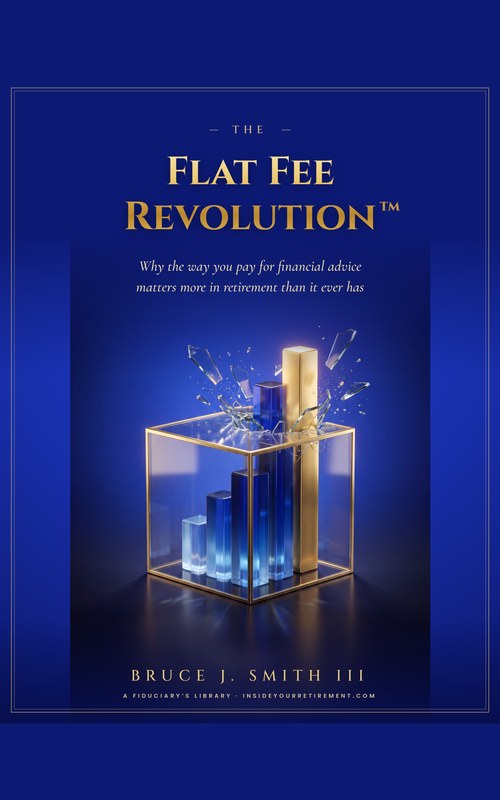 Read it free →
FlatFeeRevolutionBook.com
A percentage fee grows with your balance, not with the work.
$2 million to $4 million
At 1%, the fee goes from $20,000 to $40,000 a year, even though the work stays the same. And part of that balance is income tax you still owe, so part of the fee manages the government’s share.
What do you pay, in dollars, for life?
A flat fee is one number, known in advance. It isn’t always cheaper: on smaller portfolios a percentage fee can cost less, and it falls in bad years. Compare in dollars, over a whole retirement.
Nine questions about what you pay for advice.
Your FeesWhy does my advisor's fee go up when my portfolio goes up?
A percentage fee scales with the balance. If $2 million grows to $4 million, a 1% fee goes from $20,000 to $40,000 even though the work stays the same.
Your FeesAm I paying my advisor to manage money that really belongs to the IRS?
Often yes. A percentage fee is charged on the whole IRA, including the tax owed. If 25% will go to taxes, a quarter of the fee manages the government's money.
Your FeesHow do I find out what I actually paid my advisor last year?
Ask for your total fee last year in dollars, and how they're paid on everything else, including insurance.
Your FeesWhat is a flat-fee financial advisor?
You and the advisor agree on one annual dollar amount for managing your portfolio, known before the year starts. It doesn't grow just because your portfolio did.
Your FeesCan a flat fee go up over time?
Yes. Flat describes the fee's shape, not a promise. Before signing, ask what the fee has been in past years, how often it changed, and what governs changes.
Your FeesIs a flat fee always better than a percentage fee?
No. On smaller portfolios a percentage fee can cost less and it falls in bad years. The right question is what you'll pay in dollars for everything and what value you get.
Your FeesIs a flat fee a good deal if I have a smaller portfolio?
Often not. Below a certain size a percentage fee costs less; $900,000 at 0.75% is $6,750, cheaper than a $10,000 flat fee. An honest advisor will tell you so.
Your FeesWhat is the most important question to ask any advisor about how they're paid?
Ask how they are paid on everything they might recommend, not just the investment portfolio. A good advisor will welcome the question.
Your FeesWhat's the difference between a broker and a fiduciary advisor?
A broker is paid to sell; a fiduciary is paid to advise and must put the client first rather than the financial company.
Search the 174 fee questions, with page numbers.
See what you pay for advice, in dollars, for life.
The Flat Fee Revolution shows what a percentage fee costs over a thirty-year retirement, why the fee can double when the work does not, what a flat fee is and is not, who it fits and who it does not, and the questions to ask anyone about how they are paid. It is free to read on this site. Retain Your Wealth covers both bills and is sold on Amazon.
See your two bills, in dollars.
The Honest Fee and Tax Review is a no-cost, no-obligation meeting that shows what you paid for advice last year in dollars, the income tax already owed inside your retirement accounts, and what a cost-focused plan could keep in your family.
Calling? Mention code IYR-FEE
The Honest Fee and Tax Review is offered by WealthKare.com, Inc., doing business as The WealthKare Investment Center, an SEC-registered investment adviser under common ownership with Elite Wealth Network, Inc., the publisher of this site and of Retain Your Wealth. The two are not independent. Registration does not imply a certain level of skill or training. Advisory services are offered only by written agreement after delivery of Form ADV Part 2A and Form CRS.